 |
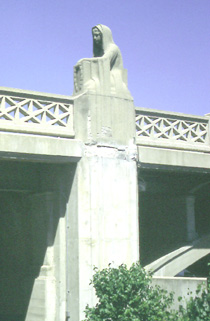
Memory, Aurora, Illinois
Adorning the New York Street Pershing Memorial Bridge, the four Memory sculptures (1931) are the creation of Emory P. Seidel, also known for creating the sculpture of Albert Einstein at the National Academy of Sciences in Washington, D.C. Each figure holds a wreath and a helmet resembling that of a WWI doughboy. The sculptures are made of aggregate concrete. The allegories' robes flow down to form the pylons of the bridge. The City of Aurora is both the owner and applicant.
|
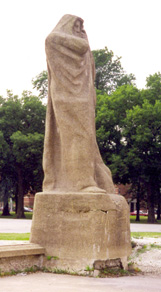 |
Fountain of Time, Chicago, Illinois
Considered to be Lorado Taft's masterpiece, this is the largest multi-figured sculpture on a single base in existence and claims to be the first to make use of concrete as an artistic medium. Fountain of Time (1922) was commissioned to commemorate the centennial of the Treaty of Ghent (1814) between the Great Britain and the United States. Lorado Taft is one of the best-known sculptors of the late nineteenth and early twentieth centuries. He compiled the first book about nineteenth-century American sculptors and sculptures, The History of American Sculpture, in 1903. Fountain of Time is owned by the Chicago Park District, which worked with the Art Institute of Chicago to preserve this national treasure.
|
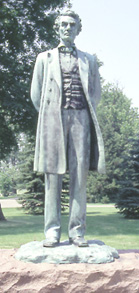 |
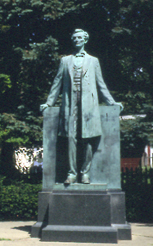
Lincoln the Debater, Freeport, Illinois
Lincoln the Debater (1929) was commissioned to commemorate the anniversary of Freeport's Lincoln-Douglas Debate (1858). Leonard Crunelle was a student of Lorado Taft, who is said to have called the sculpture "an outstanding work, one of the finest pieces of sculpture in the state." Industrialist W. T. Rawleigh ordered the commission and published the book Freeport's Lincoln to chronicle the events of the dedication. The Freeport Park District is both owner and applicant.
|
 |
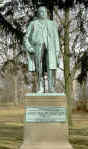
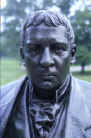
Lincoln the Lawyer, Urbana, Illinois
Originally located in front of the Urbana-Lincoln Hotel, this sculpture, completed in 1927, was a gift from Judge and Mrs. J. O. Cunningham, personal friends of Lincoln. Sculptor Lorado Taft, like Lincoln, considered Illinois to be home. The Urbana Park District is both owner and applicant. The Champaign Church of Christ, a local congregation, agreed to be trained in periodic maintenance.
|
  |
George McCulloch Statue, Muncie, Indiana
This image of the founding publisher of the Muncie Star Press was sculpted by Leonard Crunelle in 1917. The newspaper was in full support of the conservation efforts and agreed to donate up to $10,000 in advertising and promotional support for the project. The City of Muncie, Parks and Recreation Department, coordinated the conservation.
|
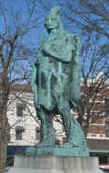 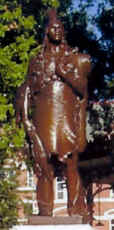 |
Chief Mahaska, Oskaloosa, Iowa
The sculpture of Chief Mahaska stands as a memorial to William Edmundson, an early Iowa pioneer. It is believed that James Edmundson, William’s son, commissioned the sculpture, created by artist Sherry Edmundson Fry and dedicated in 1909, because he thought the image of the chief embodied his father’s frontier spirit. Oskaloosa has undertaken several historic preservation projects over the years, but this was the city’s first sculpture conservation project.
|
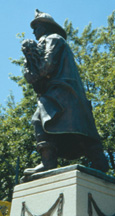 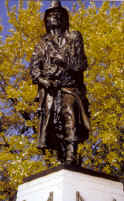 |
Fireman's Monument, St. Joseph, Michigan
On September 5, 1896, a fire at Yore's Grand Opera House in Benton Harbor, Michigan, claimed the lives of 12 volunteer firefighters. Two years after the tragedy, citizens of Benton Harbor and its "twin city" of St. Joseph raised funds to dedicate a monument to the firefighters who lost their lives in the fire. Interestingly, the Fireman's Monument, created in 1898 by W. Cottrel and owned by St. Joseph, was the first monument to be lit at night by electrical fixtures. The Krasl Art Center coordinated the sculpture's conservation.
|
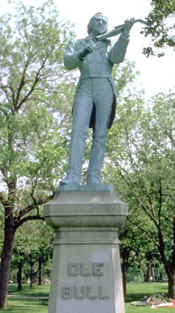 |
Ole Bull, Minneapolis, Minnesota
Fellow countryman Jakob Fjelde memorialized the great Norwegian violinist in 1896 with the first public statue in the state of Minnesota. The Sons of Norway applied in cooperation with the owner, the City of Minneapolis.
|
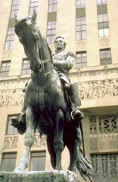 |
General Andrew Jackson, Kansas City, Missouri
The seventh President of the United States is depicted astride his horse in front of the Jackson County Courthouse. In 1934 the sculpture was unveiled by Margaret Truman, daughter of Harry S. Truman who, at the time, was the Jackson County judge and a U.S. Senator elect. Harry S. Truman is said to have kept a small replica of the statue on his presidential desk. The Historic Kansas City Foundation coordinated the conservation efforts for this sculpture by Charles Keck owned by the County of Jackson, Missouri.
|
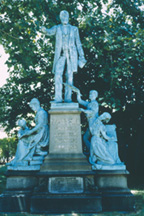 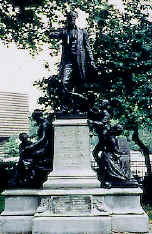 |
Harvey Rice Monument, Cleveland, Ohio
On property adjacent to the Cleveland Museum of Art stands a three-figured bronze monument to Harvey Rice, a prominent 19th-century legislator, historian, and educator in Cleveland. The Harvey Rice Monument was created by the sculptor James C. G. Hamilton in 1899, and is owned by the city of Cleveland.
The Sculpture Center, the local nonprofit group administering the project, planned to develop an educational program for students at the Harvey Rice Elementary School focusing both on Harvey Rice's legacy as the founder of Ohio’s common school system and on the need for sculpture conservation and maintenance.
|
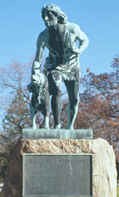 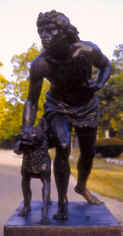 |
The Indian Hunter, Urbana, Ohio
John Quincy Adams Ward is one of the most prominent American sculptors of the late 19th century. He made his reputation as the leader of a group of post-Civil War naturalistic sculptors who depicted American themes with simple, direct naturalism. Ward's style is particularly evident in The Indian Hunter. When he died in 1910, his wife commissioned a replica, completed in 1914, to mark his grave in Urbana’s Oak Dale Cemetery. The replica, which has suffered from deterioration, underwent treatment coordinated by its owner, the city of Urbana. |