Weights and Measures
Foundation for Advancement in Conservation

© 2008
Introduction
An understanding of weights and measures in fundamental to using scientific principles in any field, including art conservation. This tutorial assumes knowledge of basic math such as orders of magnitude, ratios, and percentages.
One useful source is Prindle, Anthony; Prindle, Katie; Math the Easy Way; Easy Way Series, 4th edition; Barron's Educational Series: Hauppage, New York, 2003.
Learning Objectives
After completing this tutorial, you will be able to:
- Define a mole in terms of number of atoms or molecules and in terms of molecular weight
- Define molarity of a solution
- Calculate the amount of a solvent needed to prepare a solution of different molarity from a solution of known molarity
- Define weight/weight and weight/volume percentage of solutions
- Define percentage by volume of a solution
Press Ctrl+Shift+F to search.
Moles and Molarities
A mole is a constant. It never changes. There are always 6.023 × 10²³ units of something (atoms, molecules) in a mole.
There are exactly 12 g of carbon-12 in a mole.
6.023 × 10²³ atoms carbon-12 = 12 g
The weight of other elements depends on their relative atomic mass, that is, their mass relative to carbon-12.
The relative atomic mass of hydrogen is 1.00794. A mole of hydrogen weighs 1.00794 g.
Molarity
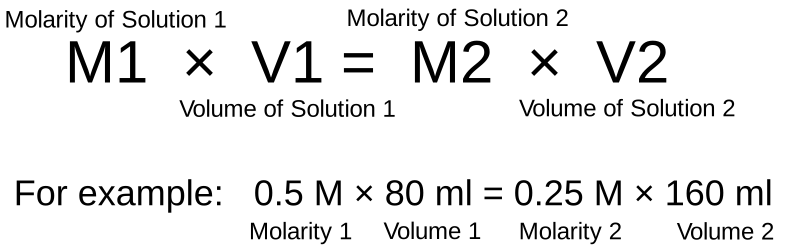
A molar solution is usually a mole of the compound made up to a liter with solvent (usually water). It isn't a mole of the compound dissolved in a liter of solvent. To prepare a solution of different molarity from a solution of known molarity use this equation:
Molarity: Worked Example
How much of a 0.6 M solution do you need to make 100 ml 0.4 M solution?
\(\text{M1} \times \text{V1} = \text{M2} \times \text{V2}\)
\(0.6\ \times\ ? = 0.4 \times 100\)
\(? = \frac{0.4\ \times\ 100}{0.6}\)
\(? = 66.67\)
Take 66.67 ml of the original solution and make it up to 100 ml with water.
Molarity: Worked Example Continued
If you take 600 ml of a 0.5 M solution and make it up to 800 ml, what would be the molarity of the new solution?
\(\text{M1} \times \text{V1} = \text{M2} \times \text{V2}\)
\(0.5 \times 600 =\ ?\ \times\ 800\)
\(? = \frac{0.5\ \times\ 600}{800}\)
\(? = 0.37\)
The new solution would be 0.37 M.
Concentrations: Weight to Volume (w/v)
The equation for this is:
\(\frac{\text{Weight of solute (g)}}{\text{Volume of solution (ml)}} \times 100\)
To make a 10% (w/v) of NaCl:
- Weigh out 10 g NaCl.
- Put it in a dry measuring cylinder.
- Fill the cylinder up to 100 ml with water.
Do not simply mix together 10 g of NaCl and 100 ml water.
Concentrations: Volume to Volume (v/v) for Solutions
The equation for this is:
\(\frac{\text{Volume of solute (Solution 1 in ml)}}{\text{Volume of solvent (Solution 2 in ml)}} \times 100\)
To make 600 ml of a 5% solution of ethylene glycol (100%) in water (v/v):
- 5% of 600 ml is 30 ml.
- Take 30 ml of ethylene glycol
- Put it in a dry measuring cylinder.
- Make up to 600 ml with water.
Do not just mix together 30 ml ethylene glycol and 600 ml water.
Concentrations: Weight to Weight (w/w)
This is slightly more complicated. The equation is:
\(\frac{\text{Weight of solute (g)}}{\text{Weight of solvent (g)}} \times 100\)
To prepare a 5% (w/w) NaCl solution in water either:
- Weigh 5 g dry NaCl in a beaker.
- Weigh 95 g water in a second beaker.
- Mix the two together.
Or:
- Weigh 5 g dry NaCl in a beaker.
- Leave the beaker on the scale.
- Add water until the weight is 100 g.
The second method may not be as accurate if you overshoot the 100 g mark.
Weights and Measures: Summary
You have learned how to:
- Define a mole in terms of number of atoms or molecules and in terms of molecular weight
- Define molarity of a solution
- Calculate the amount of a solvent needed to prepare a solution of different molarity from a solution of known molarity
- Define weight/weight and weight/volume percentage of solutions
- Define percentage by volume of a solution
Credits
Researched and written by Sheila Fairbrass Siegler
Instructional Design by Cyrelle Gerson of Webucate Us
Project Management by Eric Pourchot
Special thanks to members of the Association of North American Graduate Programs in Conservation (ANAGPIC) and the AIC Board of Directors for reviewing these materials.
This project was conceived at a Directors Retreat organized by the Getty Conservation Institute and was developed with grant funding from the Getty Foundation.
Converted to HTML5 by Avery Bazemore, 2021
© 2008 Foundation for Advancement in Conservation