Redox Reactions
Foundation for Advancement in Conservation

© 2008
Introduction
Oxidation and reduction reactions contribute to the corrosion of iron and degradation of other materials that conservators wish to preserve. An understanding of the chemistry of these reactions is key to undertaking effective preservation techniques.
Before reviewing this tutorial refresh your memory on atomic structure and the periodic table in any basic chemistry book, such as Chemistry for Dummies by John T. Moore.
Learning Objectives
After completing this tutorial, you will be able to:
- Define oxidation and reduction in terms of control of the electrons within a chemical reaction.
- Use the mnemonic OIL RIG to recall the meaning of reduction and oxidation.
- Understand the relationship between an oxidizing agent and a reducing agent.
- Understand how the activity series of elements can be used to predict what materials will be oxidized or reduced when left in contact with certain other materials over time.
Definition
Redox reactions are the transfer of the control of electrons from one reactant to another. The mnemonic for remembering these reactions is "OIL RIG".
| O | Oxidation |
|---|---|
| I | Is |
| L | Loss |
| R | Reduction |
|---|---|
| I | Is |
| G | Gain |
Electron Control
An element is:
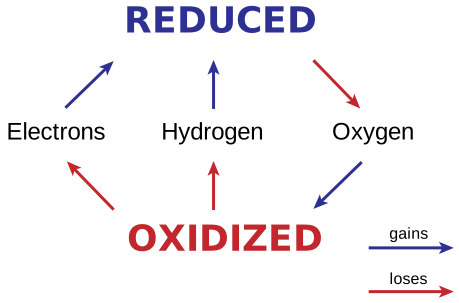
Redox Reaction
If an element is reduced in a chemical reaction, then something else must be oxidized. You can't have one without the other.
Fe (s) + CuSO4 (aq) ⟶ FeSO4 (aq) + Cu (s)
Iron is oxidized and is the reducing agent
Copper is reduced and is the oxidizing agent.
Detailed View of the Reaction
Iron the metallic state reacts with copper sulfate in solution to produce the ferrous sulfate and metallic copper.
Fe (s) + CuSO4 (aq) ⟶ FeSO4 (aq) + Cu (s)
Here is the equation without the sulfate, which is unchanged on either side of the equation.
Fe (s) + Cu2+ (aq) ⟶ Fe2+ (aq) + Cu (s)
This is easier to see if we split the equation up.
Fe ⟶ Fe2+ + 2 electrons
Cu2+ + 2 electrons ⟶ Cu
Relationship between Oxidizing and Reducing Agent
A reducing agent causes something else to be reduced and is oxidized in the process.
An oxidizing agent causes something else to be oxidized and is reduced in the process.
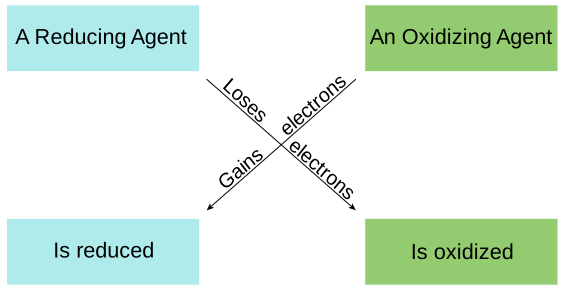
Oxidation numbers
This brings us to oxidation numbers. These can be very useful if you remember the rules.
- The oxidation numbers must add up to the charge on the molecule or ion.
- Any atom in its elemental form has an oxidation number 0.
- In compounds:
- Group 1 elements have an oxidation number +1
- Group 2 elements have an oxidation number +2
- The halogens usually have an oxidation number -1.
- Hydrogen usually has an oxidation number +1.
- Oxygen has an oxidation number -2,
- except O—O bonds where it is 0
- and in peroxides where it is -1.
Copper Sulfate Example
Let's take a look at copper sulfate (CuSO4) again.
We can write this Cu2+ SO42-.
The oxygen has an oxidation number -2 (rule 6):
4 × -2 = -8
However, there is a 2- charge on the ion, so sulfur must have an oxidation number of +6 (rule 1).
Oxidation numbers of the elements in CuSO4:
Cu = +2
S = +6
O = -2
The molecule does not have a charge so
Cu + S = +8
O × 4 = -8
If, at the end of a reaction, the oxidation number is less then the element has been reduced. If it is more, then the element has been oxidized.
Determining what is Oxidized and Reduced
Oxidation numbers can be used to determine whether an element has been oxidized or reduced in a reaction.
Let us examine the role of sulfur in the following reaction.
(Note: Do not try this. Hydrogen sulfide smells strongly of rotten eggs and is toxic.)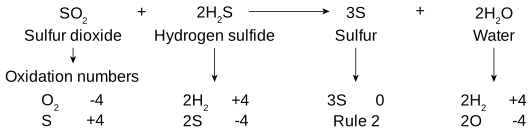
Determining what is Oxidized and Reduced Continued
In order to produce elemental sulfur with an oxidation number of 0, the sulfur in SO2 has gained 4 electrons (4 × e-) and has been reduced
(+4 → 0) and the two sulfur atoms in 2H2S have both lost two electrons
(-2 → 0) and has been oxidized.
Activity Series
Activity Series

Strongest Reducing Agent
Weakest Oxidizing Agent
Li  Lithium
Ca  Calcium
K   Potassium
Na  Sodium
Mg  Magnesium
Al  Aluminum
Mn  Manganese
Zn  Zinc
Fe  Iron
Ni  Nickel
Sn  Tin
Pb  Lead
Cu  Copper
Ag  Silver
Pt  Platinum
Au  Gold
Weakest Reducing Agent
Strongest Oxidizing Agent
Each element will reduce the ions of the elements beneath it. That is, each element will give up electrons to the elements beneath it in the series.
Each element will be oxidized by the ions of the elements beneath it.
Zn + Fe2+ ⟶ Zn2+ + Fe
Fe + Zn2+ ↛ Fe2+ + Zn
Using the Activity Series to make Predictions
Activity Series

Strongest Reducing Agent
Li  Lithium
Ca  Calcium
K   Potassium
Na  Sodium
Mg  Magnesium
Al  Aluminum
Mn  Manganese
Zn  Zinc
Fe  Iron
Ni  Nickel
Sn  Tin
Pb  Lead
Cu  Copper
Ag  Silver
Pt  Platinum
Au  Gold
Weakest Reducing Agent
Would it be possible to store a silver nitrate solution in a copper container? That is, will the following reaction occur:
Cu (s) + 2AgNO3(aq) ⟶ Cu(NO3)2 (aq) + 2 Ag (s)
Would it be possible to store a silver spoon in a zinc nitrate solution? That is, will the following reaction occur?
Ag (s) + Zn(NO3)2 (aq) ⟶ 2 AgNO3 (aq) + (aq) + Zn (s)
Activity Series

Strongest Reducing Agent
Li  Lithium
Ca  Calcium
K   Potassium
Na  Sodium
Mg  Magnesium
Al  Aluminum
Mn  Manganese
Zn  Zinc
Fe  Iron
Ni  Nickel
Sn  Tin
Pb  Lead
Cu  Copper
Ag  Silver
Pt  Platinum
Au  Gold
Weakest Reducing Agent
Summary
In this tutorial you learned:
- How to define oxidation and reduction in terms of control of the electrons within a chemical reaction
- How to use the mnemonic OIL RIG to recall the meaning of reduction and oxidation.
- The relationship between an oxidizing agent and a reducing agent.
- How the activity series of elements can be used to predict what materials will be oxidized or reduced when left in contact with certain other materials over time.
References
These articles on adhesives can be found at JAIC Online.
Credits
Researched and written by Sheila Fairbrass Siegler
Instructional Design by Cyrelle Gerson of Webucate Us
Project Management by Eric Pourchot
Special thanks to members of the Association of North American Graduate Programs in Conservation (ANAGPIC) and the AIC Board of Directors for reviewing these materials.
This project was conceived at a Directors Retreat organized by the Getty Conservation Institute and was developed with grant funding from the Getty Foundation.
Converted to HTML5 by Avery Bazemore, 2021
© 2008 Foundation for Advancement in Conservation