Adhesion
Foundation for Advancement in Conservation

© 2008
Introduction
Adhesives are used by art conservators in the restoration of all types of materials from paper and leather to stone and plaster. A good understanding of the chemistry and physics of adhesives is key to choosing and using them appropriately.
Before working through this tutorial you should read the sections on metallic, ionic, and covalent bonding in the AS and A Level Chemistry Through Diagrams (Oxford Revision Guides) or a similar basic chemistry book.
Another useful reference is The Science for Conservators Series, Volume 3: Adhesives and Coatings (Conservation Science Teaching Series), which expands on the concepts found in this tutorial and would make good follow-up reading.
Contents
This tutorial is divided into the following sections:
Please complete each section in order, as the information builds on that covered in previous sections. You can return to any section later.
Press Ctrl+Shift+F to search.
Learning Objectives
After completing this tutorial, you will be able to:
- Describe the distinction between cohesive and adhesive bonds.
- List the main types of chemical and physical forces involved in cohesive and adhesive bonds.
- Understand the importance of wetting in adhesion.
- Describe some of the solidification processes of adhesives.
- List some types of adhesive failure and criteria for testing adhesives.
Chemical Bonds
In this section you will learn that:
- There is a distinction between cohesive and adhesive bonds.
- Cohesive bonds include any of the normal chemical bonds—metallic, ionic, covalent, and Van der Waals.
- Van der Waals forces are important in the choice of cleaning solvents and behavior of adhesives.
- The four main types of Van der Waals forces are London dispersion forces, Debye forces, Kessom interactions, and hydrogen bonding.
- The three theories of adhesive bonds include mechanical, diffusion, and physicochemical concepts.
Cohesive and Adhesive Bonds
Chemical bonds: An adhesive and an adherend (or substrate) are held together by adhesive bonds.
Adhesive bonds only work over a very small distance 3–10 Angstrom. (Angstrom = 10-10 meters)
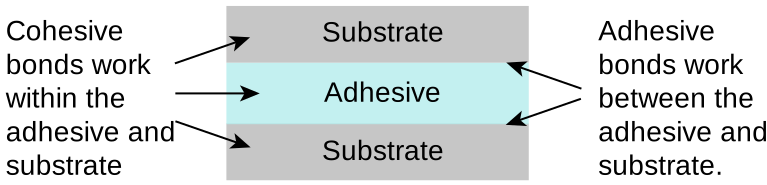
Chemical Bonds: Cohesive Bonds
The cohesive bonds in the bulk of the adhesive and substrate can be any, or all, of the normal chemical bonds.
- Metallic
- Covalent
- Ionic
- Van der Waals
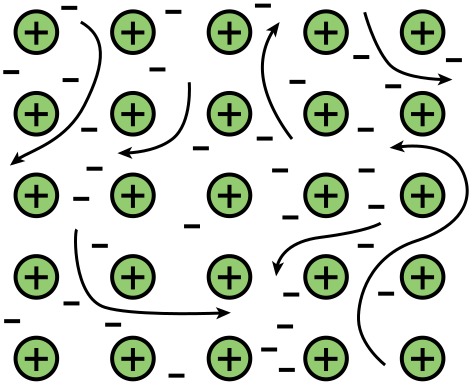
Cohesive Bonds: Metallic Bonds
The atoms in metals form lattices of ions surrounded by a sea of de-localized electrons.
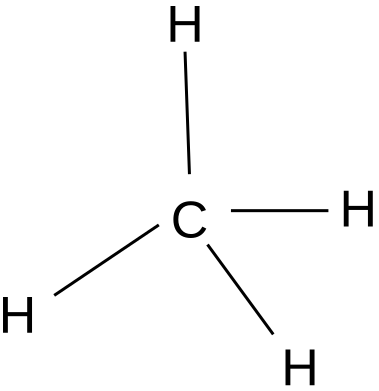
Cohesive Bonds: Covalent Bonds
The electrons are shared between the nuclei.
Cohesive Bonds: Ionic Bonds
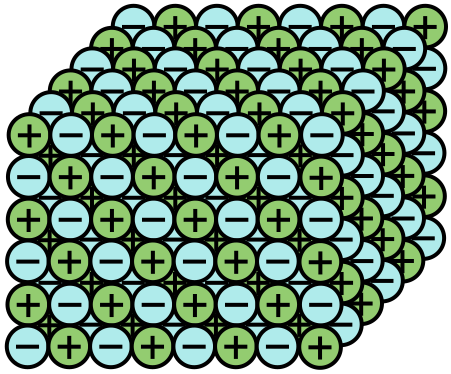
Ionic bonds are formed by permanant dipoles.
Na+ Cl-
The ions usually form into lower energy ionic lattice structures.
Cohesive Bonds: Van der Waals Forces
Van der Waals Forces: In conservation work, they play an important part in the choice of solvents for cleaning as well as in the behavior of adhesives. There are four main forces, which form a continuum from totally non-polar to a permanent partial dipole.
London Dispersion Forces: These are present in all molecules but may only play a very small part in the overall bonding.
Cohesive Bonds: London Dispersion Forces
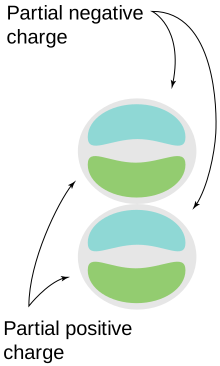
The electron cloud around the nucleus of a molecule is in a dynamic state. It fluctuates and moves very quickly
(~10-15/sec).
At any one instant there may be more electrons at one end of the molecule than the other. This causes a transient dipole and will also cause an opposite dipole on any molecules in the neighborhood.
Cohesive Bonds: London Dispersion Forces
Despite the fact that these forces are small and transient there are millions of them present. They are the main bonds holding polyethylene together.
Cohesive Bonds: Van der Waals Forces Continued
Debye Forces: These are polar attractive forces that occur when a non-polar molecule is near another with a permanent polar charge.
Keesom Interactions: Permanent partial charges caused by the unequal sharing of electrons within a molecule.
Hydrogen Bonding: A hydrogen atom attached to a strongly electronegative atom such as oxygen, nitrogen, or fluorine will have a permanent partial positive charge.
Chemical Bonds: Adhesive Bonds
There are several theories to account for adhesive bonds between two surfaces.
- Mechanical
- Diffusion
- Physicochemical
A detailed description of the physics and chemistry of adhesion can be found in “Adhesion and Adhesives—Some Fundamentals” by Keith Allen in Adhesives and Consolidants, IIC Paris Congress; 1984, pp 5–12.
Adhesive Bonds: Mechanical Bonds
In a mechanical bond, adhesive material fills the voids or pores of the surfaces and holds surfaces together by interlocking.
For example, permanent bonding between mismatched silicon structures has been reported. Micromachining techniques were used to make microscopic structures of silicon dioxide that mechanically interlock with matching, identically processed substrates in a velcro-like mechanical bond.
Although it seems obvious to rough up a surface before applying adhesive, this is only useful in a few cases (i.e. leather work).
Some roughness at a microscopic level is important, however.
Adhesive Bonds: Diffusion
Some materials may merge at the interface by diffusion. This may occur when the molecules of both materials are mobile and soluble in each other.
The ends of long polymer chains diffuse from the substrate into the adhesive and vice versa.
For this to happen the substrate and the adhesive must be very similar.
Adhesive Bonds: Physicochemical
Van der Waals Forces
London Dispersion Forces: Although these are very weak, they are plentiful and have an equilibrium attraction distance of 10 Angstrom.
Hydrogen Bonds: These are of intermediate strength and have an equilibrium attraction distance of 3 Angstrom.
Adhesive Bonds: Physicochemical
Acid-Base
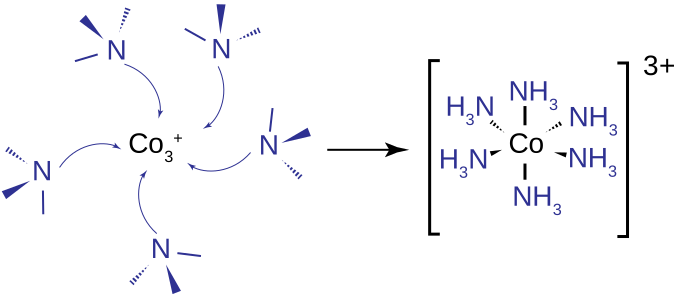
Co is acting as a base that accepts electron pairs from NH3.
Acid-base, donor-acceptor interactions may be important in some cases. This concept is based on the Lewis acid-base classification.
An acid is an atom or molecule that donates electrons to form a covalent bond.
A base is an atom or molecule that accepts electrons to form a covalent bond.
Chemical Bonds: Summary
In this section you learned that:
- There is a distinction between cohesive and adhesive bonds.
- Cohesive bonds include any of the normal chemical bonds—metallic, ionic, covalent, and Van der Waals.
- Van der Waals forces are important in the choice of cleaning solvents and behavior of adhesives.
- The four main types of Van der Waals forces are London dispersion forces, Debye forces, Kessom interactions, and hydrogen bonding.
- The three theories of adhesive bonds include mechanical, diffusion, and physicochemical concepts.
Wetting and Adhesion
In this section you will learn that:
- An adhesive must wet the surface of the substrate well.
- An adhesive will only wet a surface of higher energy than its own.
- An adhesive must solidify to hold two substrates together.
Wetting and Adhesion: Contact Angle
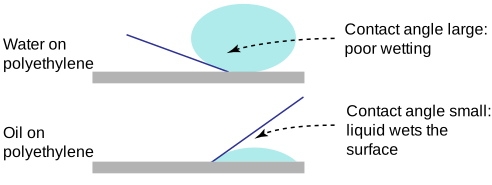
Because the adhesion bonding distances between the surface of the substrate and the surface of the adhesive are so small, the adhesive must at some point be able to flow in order to cover the surface, i.e. be above its glass transition temperature. (See separate tutorial on Tg.) The adhesive should be chosen so that it wets the surface of the substrate.
Wetting and Adhesion: Surface Energy
Surfaces that have partial, polar charges such as metals or acrylics are naturally higher in energy than non-polar surfaces such as polyethylene or silicones.
An adhesive will only wet a surface of higher energy than its own. This is the reason that water based adhesives, that have a high energy (water is polar), will not wet greasy, waxy surfaces that have a low energy.
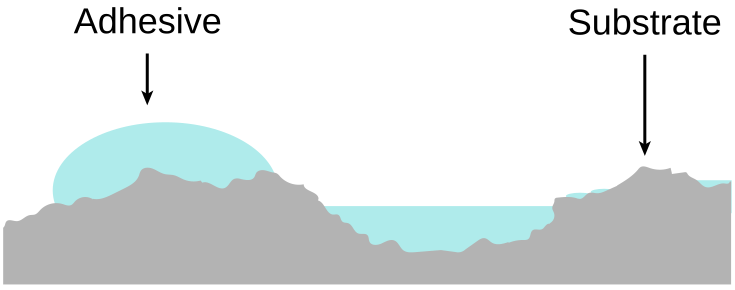 Micro and macro roughness of the substrate surface will also help the adhesive to wet it although the result may not be a continuous film.
Wetting and Adhesion: Solidification
When an adhesive has to wet the substrate surface(s) in a liquid or viscous state, it has to solidify so that it can hold the two substrates together. There are several ways this can happen.
| Liquid to Solid | Example |
|---|---|
| Loses heat | Hot melt adhesives |
| Chemical reaction such as cross-linking | Epoxies, UV cured adhesives |
| Solvent evaporation | Wheat starch paste, modified cellulose adhesives |
| Gels then solidifies | Animal glue, fish glue |
| Dispersant evaporates | Emulsions such as PVA |
| Tacks but does not dry | Pressure sensitive adhesives, Post-it notes |
Wetting and Adhesion: Summary
In this section you learned that:
- An adhesive must wet the surface of the substrate well.
- An adhesive will only wet a surface of higher energy than its own.
- An adhesive must solidify to hold two substrates together.
Adhesive Failure, Testing, and Criteria
In this section you will learn that:
- Adhesive failure means that the adhesive no longer holds the substrates together.
- A clean separation between the adhesive and substrate almost never occurs when there is failure.
- The performance tests on adhesives include tests for shear, tensile stress, peeling, and cleavage.
- The terms stress and strain are not interchangeable. They have two distinct meanings.
- ASTM has developed standard test methods that are useful.
Adhesive Failure: Defined
In adhesive science, when the adhesive no longer holds the substrates together this is termed “adhesive failure” not “reversal”.
Conservators like adhesives that do not lose their properties over time and that fail on demand.
Adhesive Failure: Modes of Failure
Diagram of the theoretical modes of failure.
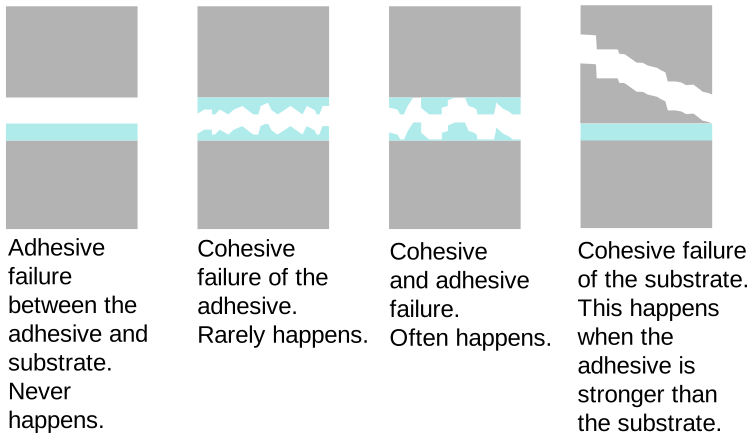
Adhesive Failure: Failure between Adhesive and Substrate

Although this is the mode of failure conservators would like, there is always some part of the adhesive
left on the surface of the substrate, although you might need a microscope or sensitive analytical technique to find it.
Adhesive Testing: Tests
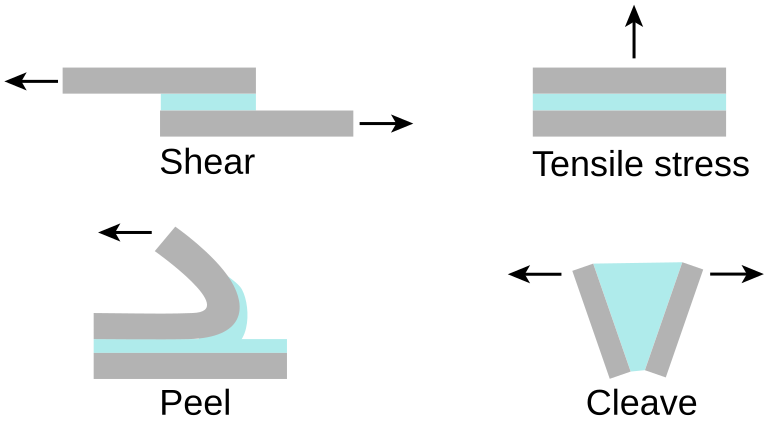 Conservators often run their own tests on adhesives to assess their performance. Once the adhesive has been applied and dried
(and/or aged) it can be pulled apart in several ways.
Conservators often run their own tests on adhesives to assess their performance. Once the adhesive has been applied and dried
(and/or aged) it can be pulled apart in several ways.
These tests are not interchangeable. You can only compare the results from similar tests. Arrows indicate the direction of the force.
Adhesive Testing: Measuring Stress and Strain
The terms stress and strain are not interchangeable.
Stress is the amount of force applied over a given area.
Strain is the amount of deformation that happens when stress is applied.
Adhesive Testing: Measuring Stress and Strain
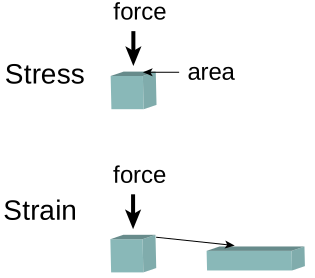
Stress is measured by the ratio \(\frac{\text{force}}{\text{area}}\)
Strain is measured by the ratio \(\frac{\text{change in size}}{\text{original size}}\)
Adhesive Testing: Standard Tests
Help with devising a good experimental set-up can be found in the ASTM Standards (American Society for Testing and Materials).
ASTM D903-98 (reapproved 2004)
Standard test method for peel or stripping strength of adhesive bonds
ASTM C961-06
Standard test method for lap shear strength of sealants
Unless you are a member of ASTM you will have to ask to read these standards in a reference library.
Adhesive Criteria: Some Some Selection Criteria for Adhesives
- solvent sensitivity of original materials
- adhesive and cohesive strength requirements
- level of reversibility required
- level of color stability required
- loss of adhesive or cohesive strength over time
- surface area of join
- surface penetration desirable or not
- optical saturation problems
- surface preparation required
- join support required throughout cure
Adhesive Criteria: Some Some Selection Criteria for Adhesives
- surface activity problems
- pH
- adhesive and substrate interactions
- gap filling requirements
- pot life
- cure time
- temperature and humidity exposure after join
- cost/availability of adhesive
The selection criteria for adhesives are probably better dealt with in depth through workshops, lectures or discussions. This list of the considerations when choosing an adhesive is taken from the AIC workshop on adhesives.
Adhesive Failure, Testing, and Criteria: Summary
In this section you learned that:
- Adhesive failure means that the adhesive no longer holds the substrates together.
- A clean separation between the adhesive and substrate almost never occurs when there is failure.
- The performance tests on adhesives include tests for shear, tensile stress, peeling, and cleavage.
- The terms stress and strain are not interchangeable. They have two distinct meanings.
- ASTM has developed standard test methods that are useful.
References
These articles on adhesives can be found at JAIC Online.
Credits
Researched and written by Sheila Fairbrass Siegler
Instructional Design by Cyrelle Gerson of Webucate Us
Project Management by Eric Pourchot
Special thanks to members of the Association of North American Graduate Programs in Conservation (ANAGPIC) and the AIC Board of Directors for reviewing these materials.
This project was conceived at a Directors Retreat organized by the Getty Conservation Institute and was developed with grant funding from the Getty Foundation.
Converted to HTML5 by Avery Bazemore, 2021
© 2008 Foundation for Advancement in Conservation