

Preserving Memory: America's Monumental Legacy Exhibit
The SOS! exhibit, Preserving Memory: America�s Monumental Legacy was on display at the New Jersey State Museum�s Galleries in Trenton, New Jersey, from September 9-October 21, 2006. It complemented Empty Sky, an exhibit that featured the design for the New Jersey September 11, 2001, Memorial at Liberty State Park.
Preserving Memory: America’s Monumental Legacy, a touring exhibit telling the stories behind America�s outdoor sculpture, was developed by Save Outdoor Sculpture!
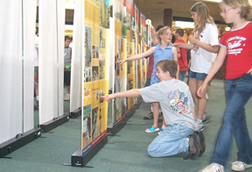
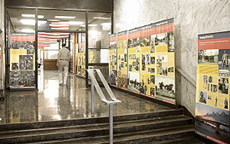 The exhibit was a series of 20 full-color panels featuring nearly 200 artworks. Visitors were encouraged to consider the impulses behind the creation of public sculpture and to reflect on their own community�s origins memorialized through its monuments.
Preserving Memory also explained some of the most common physical threats to outdoor sculpture. It featured communities that have taken steps to preserve these local and national treasures. Special panels for children presented information about dogs, horses, secrets, and diseases as portrayed in sculpture.
Made possible with the generous support of the National Endowment for the Humanities, Preserving Memory appeared in venues all over the country from September 2002 through April 2005 (click here for a list of venues).
Public sculpture, monuments, and memorials record our history in brief. They reflect our community goals and collective consciousness. They are memory aids, a sort of family album, a string around each community�s finger. Preserving Memory explains who and what achieves �monumental status� and gives insight into the process. It also tells the stories of public sculpture ranging from �found� art by self-taught artists to totem poles to commemorative fountains to the Statue of Liberty.
 Preserving Memory is full of fascinating, little known stories and shows the various ways sculpture conveys those tales. These include:
-
Biddy Mason was a slave who moved to California with her owners. After winning her freedom she became a well-known midwife, landowner, and philanthropist in Los Angeles. A memorial erected at the site of her home in 1989 uses objects as symbols of her many noteworthy activities.
In 1852 Clark Mills received a commission for an equestrian sculpture of President Andrew Jackson. To show his subject�s vitality, Mills decided to show him on a horse in motion, even though at that time no one in America had ever been able to cast a rearing horse. Mills figured it out, becoming the first American sculptor to master this technical challenge. The result can be seen in Washington, D.C., New Orleans, Louisiana, and Nashville, Tennessee.
The Statue of Liberty in New York harbor has 200 little sisters. In the 1950s the Boy Scouts of America celebrated their 40th anniversary by selling 8-foot-tall replicas of Lady Liberty that were installed in towns nationwide.
Memorials have a particular importance in America today. After Oklahoma City�s 1995 bombing, an impromptu memorial with notes, photographs, and flowers was incorporated into the permanent memorial at the site. In New York City a statue of George Washington in Union Square and a memorial to New York�s fallen firefighters in Riverside Park were focal points for public grieving after September 11, 2001.
The exhibit also showed individuals and communities saving sculpture from the effects of weather and use. For instance, when a beloved playground sculpture in Nashville, Tennessee, began showing its age, the community teamed up with a conservator to repair it. Two Dragons by Pedro Silva had been covered with mosaic tile, originally designed by the sculptor with local adults and children. The tiles were removed and numbered, and a moisture problem inside the sculpture was resolved. Then the tiles were replaced, like a giant jigsaw puzzle.